FreeCell Solitaire with every card face up
Every card face up, four free cells - Nearly every game winnable.How to Play FreeCell Solitaire
In a nutshell: Every card face up, four free cells - Nearly every game winnable. You play with 1 deck (52 cards), it's rated pure skill, and 99.999% of deals are winnable.
FreeCell deals the entire deck face up into eight columns, so nothing is hidden and nearly every game can be won - It's pure strategy. Four free cells act as temporary parking spots. The catch: you can only move as many cards at once as your free cells and empty columns allow. Because there is no hidden information and almost every deal is solvable, FreeCell is widely regarded as the purest test of skill in solitaire: a loss is nearly always a mistake rather than bad luck. That openness makes it ideal for players who enjoy thinking several moves ahead, and it is why FreeCell has a devoted following of solvers who study individual deal numbers and compete to finish in the fewest moves.
FreeCell at a glance
| Goal | Build the four foundations from Ace to King by suit. |
|---|---|
| Decks used | 1 standard 52-card deck - 52 cards in play |
| Difficulty | Pure skill |
| Chance of winning | 99.999% of deals are winnable |
| Family | Classic |
Step by step

Goal
Build the four foundations from Ace to King by suit.
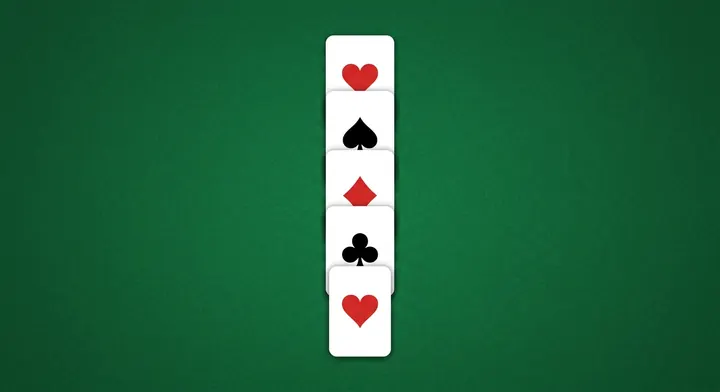
Tableau
Eight columns build down in alternating colors. All cards are dealt face up.
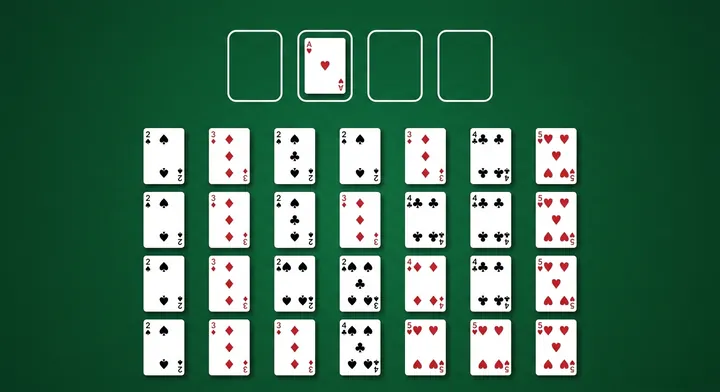
Free cells
Four cells each hold one card. Use them as temporary storage - But a full set of cells paralyzes the game.

Moving runs
You can move (free cells + 1) × 2^(empty columns) cards as a unit. With all cells free and no empty columns, that's a 5-card run.
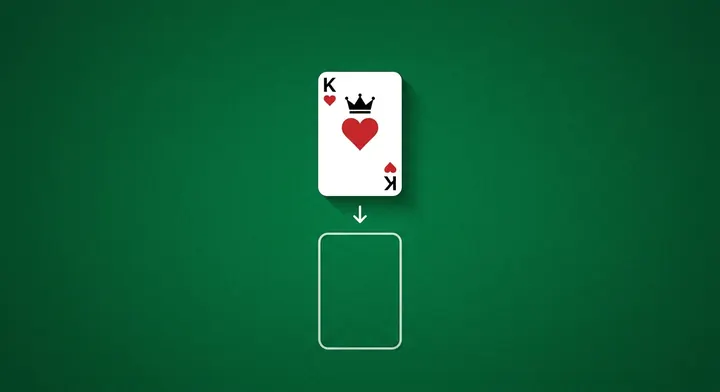
Empty columns
Any card may start an empty column.
History of FreeCell
FreeCell's mechanics descend from older patiences such as Eight Off and Baker's Game, which used similar reserve cells and same-suit or alternating-color building. The modern game, however, has a precise and well-documented origin.
In 1978, medical student Paul Alfille programmed FreeCell for the PLATO educational computer system at the University of Illinois. His version standardized the eight columns and four free cells that define the game today, and PLATO's networked terminals let it build a devoted following among early computer users.
FreeCell reached a mass audience when Microsoft included it with Windows, first as part of the Windows 95 entertainment pack and then bundled with the operating system itself. Microsoft numbered 32,000 specific deals, and a famous community effort eventually established that of those, only game #11982 is unsolvable. That near-total solvability, combined with every card being dealt face up, cemented FreeCell's reputation as the thinking player's solitaire, where losses come from mistakes rather than bad luck.
How to Win FreeCell: Strategy
💡 Top tip: Free the Aces and low cards early - Trace where they're buried before your first move.
Winning tips, in order of importance
- Keep free cells empty. Every occupied cell halves your mobility.
- Empty a short column early; an empty column is worth more than two free cells.
- Plan complete unbury-sequences before you commit: FreeCell rewards looking 4–6 moves ahead.
- Don't automatically send cards to the foundations - A 3 you foundation too early may strand a black 2 in the tableau.
- Solve the deal on paper in your head first: because everything is visible, you can often trace a full winning line before making a single move.
- When two sequences can be merged, do it early to consolidate your columns and free up a whole column as maneuvering space.
Advanced tactics for FreeCell
- Because your movable-run size is (free cells + 1) doubled per empty column, guard empty columns jealously; one empty column can be worth more than every free cell combined.
- Avoid filling all four cells at once, because a fully occupied set of cells reduces your effective run size to a single card and often locks the game.
- Plan the full unburying of a needed low card before you start, since committing cells to a half-finished maneuver is the most common way to strand yourself.
- Send a card to its foundation only when you are certain no tableau sequence still needs it as a landing spot, particularly for middle ranks.
- When emptying a column, prefer to leave it empty as a maneuvering space rather than immediately refilling it, unless doing so directly unlocks a foundation card.
- Work toward building long ordered tableau sequences that can be relocated in one large supermove once you have freed enough cells and columns.
- If two lines of play look equal, choose the one that keeps the most cells and columns free, preserving flexibility for the unforeseen block ahead.
Common FreeCell mistakes to avoid
- Filling all four free cells early - it paralyzes your moves, keep at least one open so you can still shift a run.
- Sending mid-rank cards to the foundation too soon - a 3 played up too early can strand a black 2 that needed it.
- Refilling an empty column right away - an empty column multiplies how many cards you can move, so keep it as work space.
- Moving cards before reading the whole deal - everything is face up, so trace the full unbury line before you commit a single cell.
FreeCell Variations
Baker's Game
An older relative of FreeCell in which the tableau builds down in the same suit rather than alternating colors, making it considerably harder while keeping the four free cells.
Eight Off
A direct ancestor with eight reserve cells (usually pre-filled) and same-suit tableau building, generally easier than FreeCell thanks to the extra storage.
ForeCell
A variant where the free cells and columns are dealt differently and only Kings may start an empty column, tightening the game's flexibility.
Two-deck FreeCell
Uses 104 cards, more columns, and additional free cells for a longer game that keeps FreeCell's open-information, skill-driven character.
Different cell counts
Adjusting the number of free cells (fewer for a harder game, more for an easier one) is a common way to tune FreeCell's difficulty.
FreeCell FAQ
Is every FreeCell game winnable?
Almost. Of the original 32,000 Microsoft deals only #11982 is unwinnable. Across all possible deals, about 99.999% can be won with perfect play.
How many cards can I move at once?
(Empty free cells + 1), doubled for each empty column. Four free cells and one empty column let you move 10 cards.
Why is FreeCell considered a skill game?
All 52 cards are visible from the start, so there's no luck of the draw during play - Only planning. Losses are almost always avoidable errors.
Where does FreeCell come from?
It descends from Eight Off and was popularized by Paul Alfille's 1978 PLATO implementation, then made famous by Windows 95.
What is the best opening move in FreeCell?
There is no single best move because every deal differs, but a strong habit is to first locate all four Aces and 2s and plan the sequence that will free them without clogging your cells. Since all cards are visible, treat the opening like a chess position and read several moves ahead before touching anything.
What do the free cells actually do?
Each of the four free cells holds exactly one card as temporary storage, letting you park a card that is in the way so you can reach what is beneath it. The catch is that they are a limited resource: the more cells you fill, the fewer cards you can move as a group, so a full set of cells often means a stuck game.
Why can't I move a long sequence at once?
FreeCell only lets you move one card at a time, but empty free cells and empty columns let the game shift several cards as if they were a unit. The formula is (free cells + 1) multiplied by two for each empty column, so with all four cells free and one empty column you can move ten cards in a single supermove.
Is FreeCell good for your brain?
FreeCell is often recommended as a light mental workout because it rewards planning, working memory, and sequencing rather than luck. While no card game is a guaranteed cognitive cure, the deliberate, look-ahead style of play makes it more of a puzzle than a pastime.
How is FreeCell different from Klondike?
In Klondike most cards start face down and you draw from a stock, so luck plays a large role. In FreeCell every card is dealt face up with no stock at all, and you get four free cells to maneuver, which removes almost all luck and turns the game into pure strategy.
What is the goal in FreeCell?
The goal is the same as Klondike: build all four foundations up from Ace to King, one per suit. The difference is in how you get there, using eight tableau columns and four free cells with every card visible from the start.
Which FreeCell deal is impossible to win?
Among Microsoft's original 32,000 numbered deals, only game number 11982 has been proven unsolvable, with a few others in extended numbering. Across the full universe of possible deals, roughly 99.999 percent can be won with perfect play, so a loss almost always means a mistake.
Should I always empty a column in FreeCell?
Empty columns are extremely powerful because they multiply how many cards you can move at once, so creating one is usually a strong goal. The caveat is not to empty a column at the cost of clogging all four free cells, which would leave you unable to use the space you just made.
FreeCell guides & strategy
- How to win FreeCell: a full strategy guide
- Are all solitaire games winnable? The odds
- More solitaire strategy guides on the blog
Still have a question about FreeCell Solitaire? Browse the full solitaire FAQ, look up a term like classic or pure skill in the solitaire glossary, or compare FreeCell with the other games in the rules for every solitaire.
Last updated .