Spider Solitaire, dealt fresh every game
Build eight full King-to-Ace runs across ten columns.How to Play Spider Solitaire
In a nutshell: Build eight full King-to-Ace runs across ten columns. You play with 2 decks (104 cards), it's rated 1 suit easy · 4 suits expert, and 1-suit ~95% winnable with good play.
Spider deals two full decks across ten tableau columns. Build sequences down regardless of suit, but only same-suit runs move together - And only a complete King-to-Ace run in one suit leaves the table. One-suit Spider is a relaxing classic; four-suit Spider is one of the hardest solitaire games ever devised. The name refers to the eight foundations a spider's eight legs - And the game is unusual in that you never touch a separate foundation pile by hand: runs complete right in the tableau and lift off automatically. That makes Spider a game of patient in-column construction, where the real skill is reserving space, keeping same-suit runs intact, and choosing exactly when to trigger each irreversible deal from the stock.
Spider at a glance
| Goal | Assemble eight complete runs from King down to Ace in the same suit. Each finished run flies off to a foundation. |
|---|---|
| Decks used | 2 standard 52-card decks - 104 cards in play |
| Difficulty | 1 Suit easy · 4 Suits expert |
| Chance of winning | 1-suit ~95% winnable with good play |
| Play modes | 1 Suit, 2 Suits, 4 Suits |
| Family | Classic |
Step by step

Goal
Assemble eight complete runs from King down to Ace in the same suit. Each finished run flies off to a foundation.
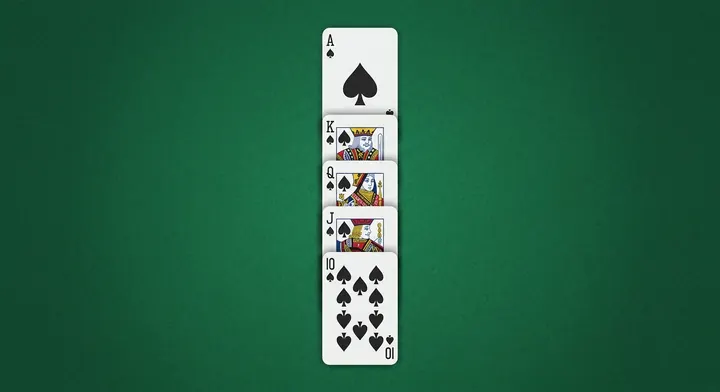
Tableau
Cards build down in rank regardless of suit, but a group can only be picked up if it's a same-suit descending run.
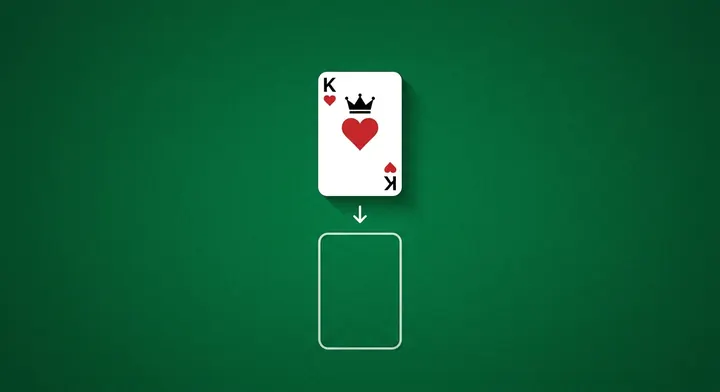
Empty columns
Any card or movable run may be placed on an empty column.
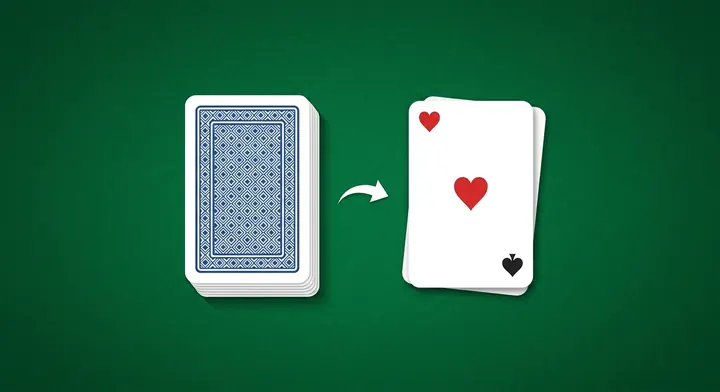
Stock
Click the stock to deal one new card onto every column - But only when no column is empty.
Suits
1 Suit uses spades only, 2 Suits adds hearts, 4 Suits uses the full deck pattern. Fewer suits = easier moves.
History of Spider
Spider is one of the older two-deck patiences and was already documented in early twentieth-century game collections; it appears in Culbertson's and other mid-century compilations under its familiar name, a reference to a spider's eight legs matching the game's eight foundations.
For most of its life Spider was a niche pastime, harder to set up by hand than single-deck games because it needs 104 cards and ten columns. That changed when Microsoft shipped Spider Solitaire with Windows Me in 2000 and, more influentially, bundled it with Windows XP in 2001, complete with the one-, two-, and four-suit difficulty settings that are now standard everywhere.
Franklin D. Roosevelt was famously fond of Spider, and the game has long been associated with players who enjoy a longer, more cerebral sit than Klondike offers. Its modern reputation rests on that difficulty curve: one suit is a gentle warm-up, while four-suit Spider is regarded as one of the hardest solitaire games in common play.
How to Win Spider: Strategy
💡 Top tip: Empty columns are everything in Spider - Dig for them early and reuse them to re-sort broken sequences.
Winning tips, in order of importance
- Build in-suit whenever possible; off-suit builds are parking spots that eventually block you.
- Before dealing from the stock, tidy the tableau - The new row buries everything.
- Expose face-down cards in the tallest piles first.
- In 4 Suits, prioritize completing one suit fully rather than making shallow progress in all of them.
- Keep your ten columns as even as possible before a deal, since a very tall column is likely to swallow a card you need after the next row lands.
- Turn off-suit stacks back into same-suit order at the first chance, because only same-suit runs can move as a group or lift off as a finished pile.
Advanced tactics for Spider
- Treat off-suit stacking as a temporary loan; whenever you can, rebuild those cards into same-suit order so a completed run can eventually lift off in one piece.
- Try to keep at least one column short or empty going into a stock deal, because a fresh row dumped onto ten packed columns can bury a nearly finished run.
- When you must break a sequence, break the one that gives the most immediate same-suit continuations rather than the one that simply looks tidiest.
- In four-suit games, commit early to which suit you will complete first and funnel your best cards toward it instead of spreading progress thinly.
- Watch for cards you will need to un-bury later; if the last 2 of a suit sits deep under an off-suit pile, plan the empty column that will free it.
- Deal from the stock only after squeezing out every rearrangement, since each deal is irreversible and you have a limited number of them.
- Preserve a King with a clear column as a home base; Kings are the top of every run and having a place to start one prevents deadlocks.
Common Spider mistakes to avoid
- Building off-suit when an in-suit move exists - off-suit stacks become blockers that only an empty column can untangle later.
- Dealing from the stock before tidying the board - each new row buries your progress and every deal is irreversible.
- Wasting empty columns on random cards - a gap is your most valuable resource for re-sorting broken sequences, so use it deliberately.
- In four-suit games, spreading thin across all suits - commit to completing one full King-to-Ace run before chasing the rest.
Spider Variations
One, two, and four suits
The standard difficulty ladder: one suit (all spades) is a relaxed puzzle, two suits adds hearts for moderate challenge, and four suits uses the full deck for expert-level play.
Spiderette
A single-deck version dealt into seven columns like Klondike, giving a quicker Spider-style game that fits 52 cards.
Black Widow
A Spider variant in which any descending sequence can be moved as a group regardless of suit, removing the same-suit movement restriction for a faster game.
Gigantic Spider
Played with additional decks and more columns for marathon sessions, scaling Spider's mechanics up for players who want an even longer game.
Relaxed / unlimited redeals
Rule sets that allow dealing from the stock even with empty columns, or that permit undo, softening Spider's strict deal requirement.
Spider FAQ
How many cards are in Spider Solitaire?
104 - Two standard 52-card decks. Fifty-four are dealt into the ten tableau columns and fifty stay in the stock, dealt ten at a time.
Is 4-suit Spider really winnable?
Yes, but rarely by casual play. Estimates put perfect-play winnability high, yet even strong players win well under 20% of 4-suit deals without undo.
Why can't I deal from the stock?
Spider requires every column to hold at least one card before a new row can be dealt. Fill empty columns first - Even with a single throwaway card.
What's the best starting strategy?
Make in-suit builds and flip face-down cards before anything else. The first two deals decide most games.
How long does a game of Spider take?
One-suit games often finish in five to ten minutes, while a hard-fought four-suit game can run twenty minutes or more. Because there is no auto-win shortcut until runs are assembled, the endgame of clearing the last columns can be the longest part.
What is the best suit level for a beginner?
Start with one suit, which uses only spades and lets you focus on the flow of building down and freeing columns without worrying about matching suits. Move to two suits once that feels easy, and attempt four suits only when you are comfortable planning several moves ahead.
How do I create an empty column in Spider?
Empty columns come from clearing out short piles, so early in the game favor moves that reduce your shortest columns rather than piling more cards onto them. An empty column is the single most valuable resource in Spider because you can drop any card or movable run into it to re-sort the board.
Why did I run out of moves in Spider?
Spider deadlocks when every column is blocked by an out-of-order card and you have no empty column and no legal stock deal. This usually traces back to dealing from the stock too early, burying a run you needed, or letting off-suit stacks pile up without a plan to rebuild them.
Does Spider have a foundation like Klondike?
Not one you interact with directly. When you assemble a full King-to-Ace run in a single suit, the game automatically removes it to a foundation area, so your entire effort happens within the ten tableau columns.
How many cards are dealt to the tableau in Spider?
Fifty-four cards are dealt to the ten columns at the start, with the first four columns holding six cards and the remaining six holding five each. Only the bottom card of each column starts face up; the other fifty cards stay in the stock to be dealt ten at a time.
Why does dealing require every column to be filled?
The rule that no column may be empty when you deal from the stock is what gives Spider much of its difficulty. It forces you to fill any gaps first, even with a stray card, which can undo careful work, so you must weigh emptying a column against your need to deal later.
Is Spider Solitaire good for your brain?
Like other planning-heavy solitaires, Spider exercises working memory, sequencing, and forward thinking as you track which runs to preserve and when to deal. It won't work miracles, but it is a pleasant, low-pressure way to keep your mind engaged.
Spider guides & strategy
- Spider strategy: how to beat 1, 2 and 4 suits
- Are all solitaire games winnable? The odds
- More solitaire strategy guides on the blog
Still have a question about Spider Solitaire? Browse the full solitaire FAQ, look up a term like classic or 1 suit easy · 4 suits expert in the solitaire glossary, or compare Spider with the other games in the rules for every solitaire.
Last updated .