Golf Solitaire, where the low score wins
Clear seven columns onto the waste - Lowest score wins.How to Play Golf Solitaire
In a nutshell: Clear seven columns onto the waste - Lowest score wins. You play with 1 deck (52 cards), it's rated simple, subtle, and roughly 1 in 3 deals clear.
Golf deals 35 cards into seven face-up columns. Like TriPeaks, you play cards one rank up or down onto the waste, but with no wrap-around and no second chances - Every leftover card counts against your score, just like strokes in golf. Golf is deceptively simple: a single rule governs every move, yet the strict structure - No rank wrap-around and only one pass through the stock - Means many deals cannot be cleared at all. That turns Golf into a scoring game as much as a winning one, where players compete to leave as few cards behind as possible and chase the elusive hole-in-one of an empty tableau. Its tiny footprint and quick rounds have made it a fixture of solitaire collections for decades.
Golf at a glance
| Goal | Move all 35 tableau cards to the waste pile. Leftover cards are penalty points. |
|---|---|
| Decks used | 1 standard 52-card deck - 52 cards in play |
| Difficulty | Simple, subtle |
| Chance of winning | Roughly 1 in 3 deals clear |
| Family | Matching |
Step by step
Goal
Move all 35 tableau cards to the waste pile. Leftover cards are penalty points.
Moves
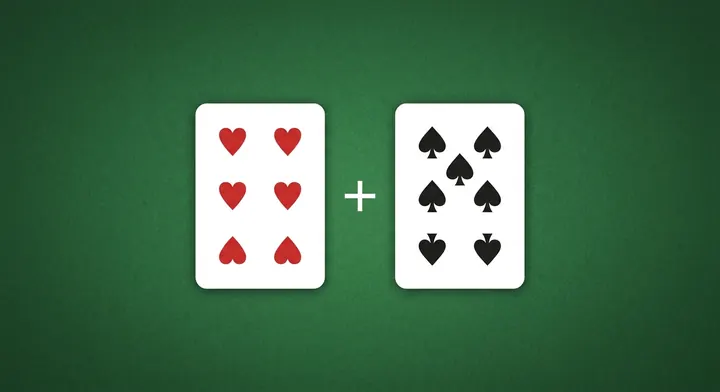
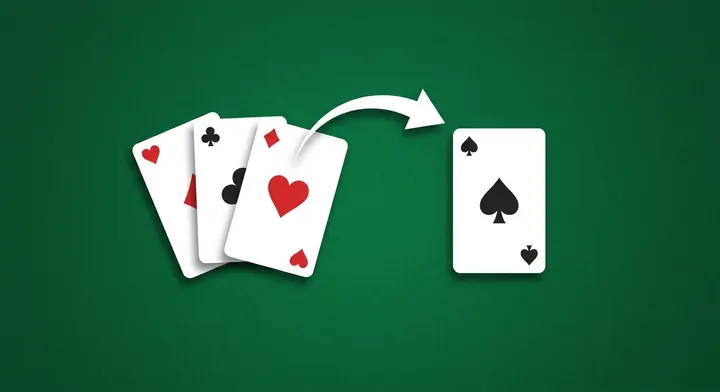
Play the bottom card of any column if it's one rank above or below the waste card.
No wrap
In classic Golf, nothing plays on a King except… nothing. Kings are chain-enders (Aces only link to 2s).
Stock
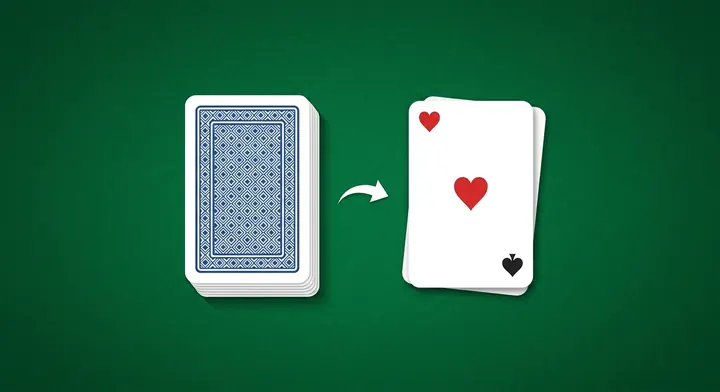
Flip a stock card when no play exists - 17 flips and they're gone.
Scoring
Your score is the number of cards left when the stock runs dry. Zero is a hole-in-one.
History of Golf
Golf solitaire is a tableau-clearing patience named for its scoring rather than its layout. Just as in the sport, the aim is a low score: every card left stranded when the stock runs out counts against you, and clearing the whole board is the equivalent of a perfect round.
The game sits in the same family as TriPeaks and other "playing off" patiences, in which cards are discarded onto a single waste pile in ascending or descending order. Golf is generally considered the more austere ancestor of that group, because classic rules forbid rank wrap-around - Nothing plays on a King - And allow only a single pass through the stock, with no redeals.
Golf became widely known through home computer and mobile solitaire collections, where its tiny footprint and short rounds made it an easy companion game. Its enduring appeal is the tension between a simple rule and a stingy structure: many deals cannot be fully cleared, so players compete on score, chasing that elusive hole-in-one where the entire tableau melts away in a single long chain.
How to Win Golf: Strategy
💡 Top tip: Count duplicated ranks - With four of each rank across 35 cards, some chains only exist once. Spend them wisely.
Winning tips, in order of importance
- Kings are dead ends: clear cards sitting on top of Kings early, and never strand a needed rank beneath one.
- Prefer plays from tall columns to keep all seven columns alive.
- Look two ranks ahead: a 5 on the waste with a 6 and 7 exposed is a guaranteed three-card chain.
- Late game, prioritize columns that still hide many cards over easy singles.
- Since there is no wrap-around, decide early whether a chain will run up or down and protect the connector cards that keep it going.
- When a card sits on top of a King, clear it before the King blocks the column, because nothing can ever be played onto that King to free it later.
Advanced tactics for Golf
- Plan multi-card chains before committing, since a 5 on the waste with an exposed 6 and 7 can become a guaranteed run if you play them in the right order.
- Treat Kings as dead ends; clear any cards resting on a King promptly and never bury a rank you still need beneath one.
- Spread your plays across all seven columns so none becomes stranded, because a single blocked column of leftover cards ruins an otherwise clean round.
- Since there is no wrap-around, decide early which direction (up or down) a given chain must run and don't waste the connector cards that keep it alive.
- Count how many copies of a pivotal rank remain; some chains can only be completed once, so spend those cards where they clear the most cards.
- With few stock flips left, favor plays that empty columns hiding many cards over easy single removals that leave a tall column behind.
- When two plays are otherwise equal, choose the one that preserves the most future connections on the waste rather than the one that clears the flashiest card now.
Common Golf mistakes to avoid
- Leaving cards stacked on a King - nothing plays onto a King without wrap-around, so clear those cards before it blocks the column.
- Draining one column while others sit tall - spread your plays so no single column gets stranded with hidden cards.
- Ignoring multi-card chains - a 5 on the waste with an exposed 6 and 7 is a guaranteed run if you play them in order.
- Burning a scarce connector rank on an easy single - some chains exist only once, so spend those cards where they clear the most.
Golf Variations
With wrap-around
A popular relaxation lets Kings connect back to Aces, so chains can run continuously around the rank order; this raises the win rate well above the strict version.
Multiple stock passes
Some rule sets allow recycling the waste or extra stock deals, greatly softening Golf's single-pass difficulty.
Black Hole
A close cousin dealt from a central foundation with all seventeen piles of three, building both up and down with wrap, often more solvable than standard Golf.
All in a Row
A Golf-style variant that lays all cards out at once with no stock, turning the game into a pure sequencing puzzle.
Golf scoring vs. clear-to-win
Casual apps often keep cumulative stroke scores across rounds like a full round of golf, while others simply mark each deal as won only if the board is fully cleared.
Golf FAQ
Why is it called Golf Solitaire?
Because you count strokes: every card left on the table when the stock is exhausted adds to your score, and lower is better. Clearing everything is an ace.
Can I play a card on a King?
In classic rules, no - Kings end a chain and nothing can be played onto them. Some variants allow King-Ace wrap; ours plays it straight.
Is Golf harder than TriPeaks?
Generally yes. No rank wrap-around and only one pass through the stock make Golf noticeably less forgiving.
What is a perfect score?
Zero cards remaining - Clearing all 35 tableau cards. Rare enough to celebrate.
Does suit matter in Golf Solitaire?
No. As in TriPeaks, only rank matters: you play a card one higher or one lower than the waste card regardless of suit or color. This keeps the game quick and focused on sequencing.
How is Golf Solitaire scored?
Your score is the number of cards left in the tableau when the stock is exhausted, and lower is better, just like strokes in golf. Clearing every card is a score of zero, the equivalent of a hole-in-one, while a stranded column of leftovers counts against you.
What is the difference between Golf and TriPeaks?
Both play cards one rank up or down onto a waste pile, but TriPeaks uses a three-peak layout, wraps ranks around from King to Ace, and rewards chains with bonuses. Classic Golf uses seven columns, forbids wrap-around, and simply counts leftover cards, which makes it more austere and generally harder.
Can I play a card on a King in Golf?
In classic rules, no. Nothing plays onto a King because there is no wrap-around, so a King ends a chain and any cards stacked on it must be cleared first. Some relaxed variants allow King-to-Ace wrap, which makes the game noticeably easier.
How many chances do I get in Golf?
In the traditional game, just one pass through the stock with no redeals, which is a major source of its difficulty. Softer versions allow recycling the waste or extra deals, but the strict single-pass rule is what makes a clean sweep so satisfying.
How many cards are dealt in Golf Solitaire?
Thirty-five cards are dealt face up into seven columns of five, forming the tableau. The remaining seventeen cards make up the stock, which you flip one at a time to the waste when no column card can be played.
What is the goal of Golf Solitaire?
The goal is to clear all thirty-five tableau cards onto the waste pile by playing cards that are one rank higher or lower than the current waste card. Every card left behind when the stock is exhausted counts as a penalty point, and a score of zero is a perfect round.
Can I move cards between columns in Golf?
No. Unlike Klondike or FreeCell, Golf has no building within the tableau; cards only ever move from the bottom of a column onto the single waste pile. This makes the game a pure sequencing puzzle rather than a construction one.
Golf guides & strategy
- The complete solitaire glossary
- Are all solitaire games winnable? The odds
- More solitaire strategy guides on the blog
Still have a question about Golf Solitaire? Browse the full solitaire FAQ, look up a term like matching or simple, subtle in the solitaire glossary, or compare Golf with the other games in the rules for every solitaire.
Last updated .