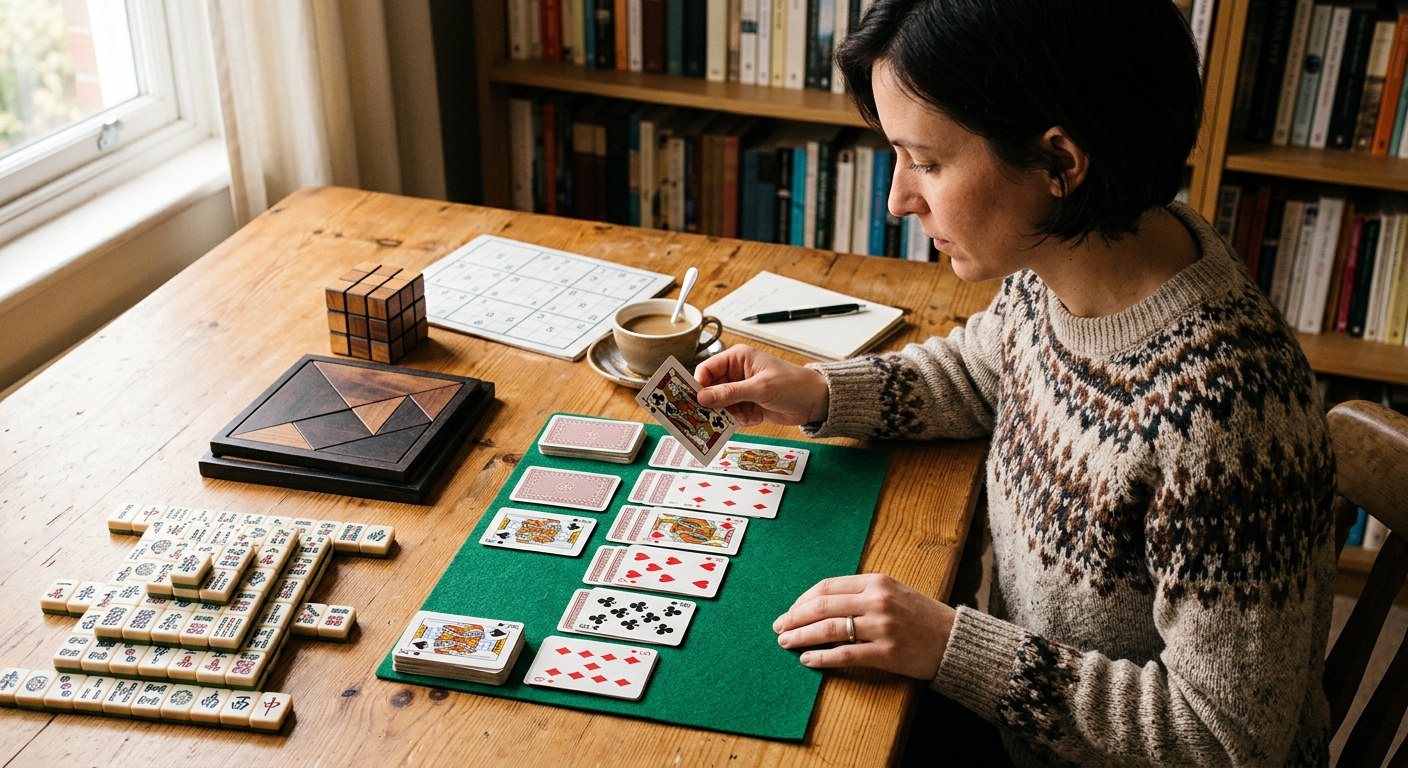
Flip three cards, scan the tableau, and make a call. That's the loop. It sounds simple, but it isn't. Every move in Klondike or FreeCell is a small act of applied reasoning, and the more you play, the more automatic that reasoning gets. Solitaire earns its reputation as a relaxing game, yet underneath the calm is a steady workout for the parts of your brain that handle risk, prediction, and pattern recognition. And those exact same skills show up in a surprising range of other solo and small-group games, if you know where to look.
Three Things Worth Knowing Before Your Next Hand
- Solitaire builds probability intuition by forcing you to estimate what is still buried in the deck with every single move.
- FreeCell is a genuine working-memory challenge, and finishing games without hints is meaningful cognitive exercise.
- Other solo games share the same core decision loop as solitaire, making them natural companions for card game fans.
The Hidden Workout Inside Familiar Card Play
There is a reason people come back to solitaire day after day. It isn't just habit. The game consistently puts you in situations where you have partial information and have to act anyway. That is a cognitively rich state to be in, and it is one that most people don't give themselves credit for navigating well.
Think about what you're actually doing in a typical game. You're holding several possible sequences in your head at once. You're weighing which move preserves the most future options. You're reading a board that changes every time you act. That is layered thinking, even if it doesn't feel that way from the inside.
The low-stakes atmosphere is a feature, not a flaw. Because the consequences are gentle, you're free to test ideas and observe what happens without anxiety. That willingness to experiment and adjust is the core loop of clear reasoning in any domain. Solitaire just packages it in a format you can access in five minutes on any device.
How Klondike Teaches You to Think in Probabilities
Klondike is the version most people picture when solitaire comes to mind. One deck, seven columns, a draw pile that may or may not hand you what you need. The tension between what you can see and what you can't is the whole game.
When you decide whether to flip a card from the draw pile or play what's already visible, you're estimating odds. You don't have to put hard numbers to it. Your brain runs a rough calculation: "There are three cards I need and maybe fifteen still in the pile. Do I wait or commit?" That intuition sharpens over hundreds of games.
Here are the specific moments in a Klondike game where probability thinking is most active:
- Deciding whether to move a card to the foundation now or keep it in the tableau as a stepping stone
- Choosing which buried card to expose when two equally valid moves are available
- Tracking which stock pile cards have already cycled through as you work the draw pile
- Recognizing when a column is locking up and acting before the position becomes irreversible
- Evaluating whether a run of cards is worth starting if the suits don't favor your current build
Each of those decisions feels small in the moment. Across a full game, they form a pattern of disciplined, probability-weighted thinking. The player who wins more often isn't luckier. They're reading the odds better.
FreeCell and the Art of Thinking Several Steps Ahead
FreeCell is a different kind of challenge entirely. Nearly every deal is technically winnable, which shifts the pressure in an interesting direction. You can't blame the cards. If you lose, a better plan would have won.
That demand for planning quality makes FreeCell one of the most rigorous solo card games you can play. Research on working memory shows that the ability to hold and manipulate information in mind at once is one of the strongest predictors of problem-solving performance. FreeCell taxes that system in a structured, repeatable way, because every meaningful move requires you to hold the consequences of several prior moves in your head simultaneously.
A solid approach to any FreeCell deal usually follows this kind of process:
- Survey the full tableau before touching anything, noting which aces and twos are accessible from the start
- Identify the most deeply buried cards and map out what has to move before you can reach them
- Treat your free cells as a limited resource rather than a holding area, since filling them all early kills your flexibility
- Build sequences in order of dependency, starting with the columns that have the fewest exits
- Revisit your plan every five or six moves as the board opens up and new paths become visible
Experienced FreeCell players often describe the game as chess without an opponent. The comparison isn't far off. There is no one to outplay and no luck to manage. The challenge is purely about the quality of your planning.
Shut the Box: The Dice Game That Speaks the Same Language
Solitaire fans who want to stretch their skills away from cards tend to gravitate toward games that demand the same "best move with what I've got" thinking. shut the box is one of the most direct examples of that type of game, and it earns its reputation quickly.
The premise is simple. Roll two dice, then flip down any combination of numbered tiles that adds up to your roll. Roll a nine and you could flip the 9 tile alone, or flip 5 and 4, or 6 and 3, or 7 and 2, or even a longer combination of smaller numbers. You keep rolling until no valid combination is left. The goal is to flip every tile before that happens.
The decision of which combination to flip is where the real thinking lives. You're not just solving a math problem. You're managing future risk. Flipping 9 as a single tile removes one number permanently. Flipping 5 and 4 leaves the 9 available for a future roll but opens the board in a different direction. That trade-off calculation, optimize now or preserve options, is the same judgment call solitaire players face constantly.
The game plays fast, usually under five minutes per round. Each game gives you an immediate measure of how well you managed your choices. Card game players tend to find the transition natural because the instinct the game rewards is essentially identical to the one that makes a good solitaire player.
How Three Solo Games Stack Up on Core Mental Demands
| Mental Skill | Klondike Solitaire | FreeCell | Shut the Box |
|---|---|---|---|
| Probability estimation | High | Low | Medium |
| Multi-step forward planning | Medium | Very High | Low |
| Pattern recognition | High | High | Medium |
| Risk management under uncertainty | High | Low | High |
| Option preservation thinking | High | Very High | High |
The table tells a clear story. No single game dominates across every dimension. Each one gives you a different angle on the same cluster of skills. Playing more than one of them fills in the gaps that any single game leaves behind.
The Skills That Cross Every Solo Game
Once you start seeing solitaire as skill-building rather than just passing time, you notice the same abilities turning up across different game formats. The games above differ in pace, medium, and setting. But the cognitive habits each one rewards are remarkably consistent.
The transferable skills that solitaire and its cousins regularly strengthen include:
- Sustained attention, the ability to stay focused through multiple decision points without losing track of earlier moves
- Mental flexibility, adapting your plan when the board changes and your original approach no longer fits the position
- Numerical intuition, building a feel for combinations and sequences through repetition rather than formal calculation
- Comfort with incomplete information, getting practiced at making good calls when you can't see everything on the board
These are not minor skills. They show up in professional settings, in strategic conversations, and in day-to-day decision-making. The fact that they can be built through low-pressure solo play is genuinely practical. You're not grinding through drills. You're playing a game you already enjoy.
Why Daily Solitaire Play Keeps Paying Off Over Time
There is a strong case that solitaire becomes more mentally valuable the longer you stick with it. Early games are about learning the rules and identifying valid moves. Later, the challenge shifts toward quality of play: sequencing, board reading, and making the most of a difficult position.
That progression matters. A game that keeps presenting new layers of difficulty doesn't plateau the way a purely mechanical task might. Both Klondike and FreeCell have depths that most casual players never fully reach. Even experienced players occasionally hit a deal that forces a new level of careful thought.
Regular play also builds the habit of deliberate attention. Sitting with a problem, resisting the urge to rush, working through your options before committing. Those habits accumulate quietly. They are hard to quantify, but players who reflect on their own thinking often report that card games have made them more patient and methodical in contexts that have nothing to do with cards at all.
That isn't a claim that solitaire rewires the brain in dramatic ways. It is simply that repeated practice with a decision-heavy activity tends to improve decision-making. Solitaire is one of the most accessible and consistent ways to get that kind of practice into a daily routine.
The Bigger Game Hiding Behind Every Tableau
Solitaire has spent decades being written off as a simple distraction. That reputation undersells it significantly. The games most people play casually, Klondike, FreeCell, and their close relatives in the solo game family, are structured exercises in probability and planning that happen to look like leisure.
The same mental habits that make a solitaire player strong, reading the board, weighing trade-offs, thinking two moves out before committing, show up clearly in other games that demand the same instincts. That consistency is not a coincidence. These games all draw from the same foundation of applied reasoning. They reward the same kind of careful, adaptive mind.
Give yourself credit for what is actually happening the next time you settle in for a game. You are not just moving cards around a screen. You are practicing a kind of thinking that holds up under pressure, transfers to real situations, and gets sharper with repetition. That is a more meaningful way to spend a spare half-hour than most people realize, and it is the reason this genre of games has endured for as long as it has.