Play Klondike Solitaire
Classic Klondike, plus the one thing most solitaire sites lack: race a friend live in real-time multiplayer. No download, no signup.Solitaire.now is a free online solitaire site with 11 classic games - Klondike, Spider, FreeCell and more - a shared daily challenge, and real-time multiplayer that lets you and a friend race the identical deal. There's nothing to download and no account required: just deal and play below.
Other games worth playing
How to Play Klondike Solitaire
In a nutshell: The classic - Build four foundations from Ace to King. You play with 1 deck (52 cards), it's rated easy to learn, and ~80% of turn 1 deals are winnable.
Klondike is the world's most popular solitaire game - The one most people simply call “Solitaire”. Build the four foundations up from Ace to King by suit, moving cards between seven tableau columns in descending order and alternating colors. Turn 1 flips one stock card at a time; Turn 3 flips three and is the tougher, purist's way to play. It is the version most people picture when they hear the word "solitaire" - The one that shipped with Windows and taught a generation to use a mouse. Beneath its familiar surface lies a surprising amount of decision-making: which face-down card to attack first, when to hold a card back from the foundations, and how to manage a limited stock all separate a lucky finish from a skillful one.
Klondike at a glance
| Goal | Move all 52 cards onto the four foundations, one per suit, built up from Ace to King. |
|---|---|
| Decks used | 1 standard 52-card deck - 52 cards in play |
| Difficulty | Easy to learn |
| Chance of winning | ~80% of Turn 1 deals are winnable |
| Play modes | Turn 1, Turn 3 |
| Family | Classic |
Step by step
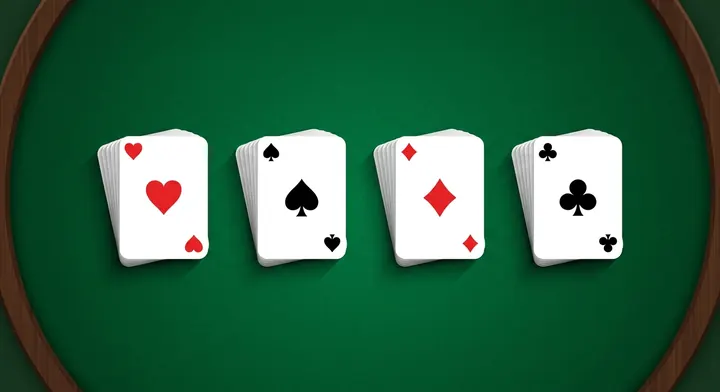
Goal
Move all 52 cards onto the four foundations, one per suit, built up from Ace to King.
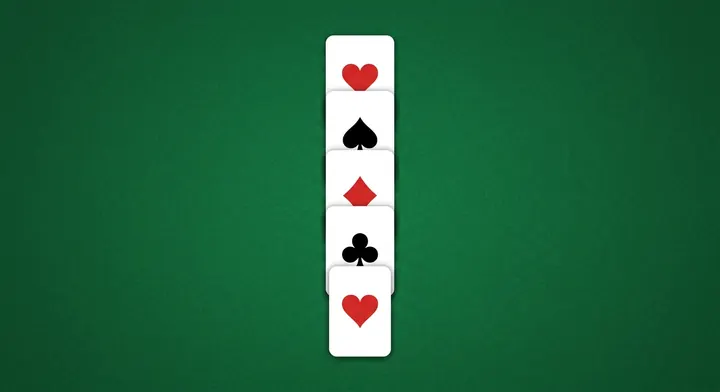
Tableau
The seven columns build down in alternating colors (red on black, black on red). Move single cards or ordered runs. Only a King may fill an empty column.
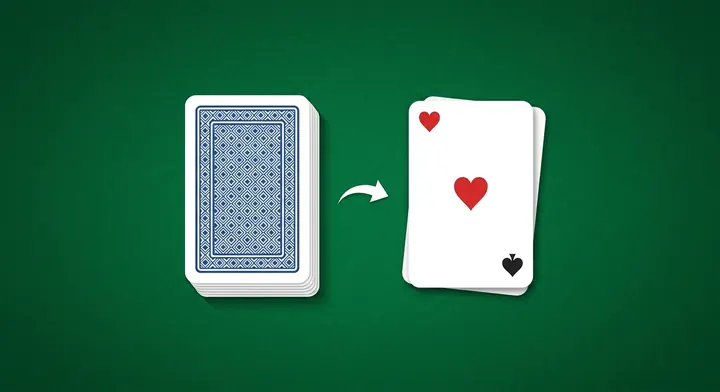
Stock & waste
Click the stock to deal cards to the waste. In Turn 1 you deal one card; in Turn 3 you deal three but can only play the top one. You may recycle the waste when the stock is empty.
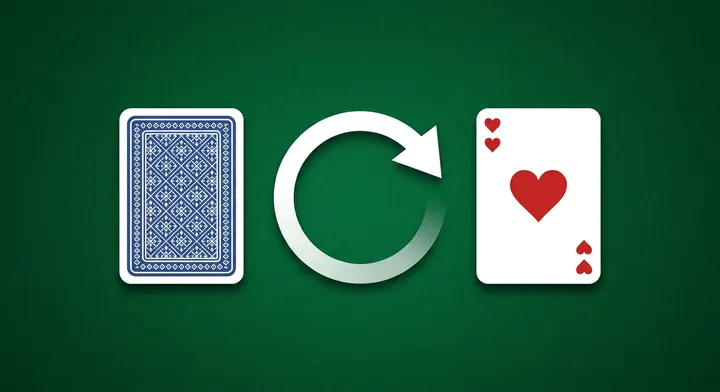
Flipping
When a face-down tableau card becomes exposed, it flips face up automatically.
Winning
The game is won when all four foundations are complete - Use auto-finish when everything is face up.
History of Klondike
Klondike takes its name from the Klondike Gold Rush of the late 1890s, when tens of thousands of prospectors poured into Canada's Yukon territory. Isolated in remote camps with long idle winters, miners are said to have passed the time with the single-deck patience game that later carried the region's name, and the association stuck.
The game spread through printed collections such as Lady Adelaide Cadogan's Victorian patience books and the many "Games of Patience" volumes that followed. For decades it was simply one of dozens of documented patiences, no more famous than Canfield or Forty Thieves.
Its explosive modern popularity came from software. Microsoft bundled a Klondike game called simply "Solitaire" with Windows 3.0 in 1990, partly to teach users the click-and-drag mouse. It became one of the most-played computer programs in history, and for hundreds of millions of people the words "solitaire" and "Klondike" now mean exactly the same thing.
How to Win Klondike: Strategy
💡 Top tip: Always flip a face-down card when you can - Exposing hidden cards is worth more than almost any other move.
Winning tips, in order of importance
- Prefer moves that free up the longest face-down piles first.
- Don't rush cards to the foundations; you may need low cards in the tableau to move other cards around.
- Empty columns are powerful but only Kings can fill them - Plan which King (and which color) you want before emptying a column.
- In Turn 3, count the waste cycle: the order of the stock repeats, so plan which third card you need to unlock.
- Deal through the entire stock once early to learn which cards are available before you commit to a risky tableau structure.
- When you have a choice of moves, build toward the colors and ranks that will let you unload the waste pile fastest.
Advanced tactics for Klondike
- When choosing which King to move into an empty column, pick the color that lets you unload the most cards from the waste and other columns immediately afterward.
- Delay recycling the stock until you have exhausted every tableau play; each pass through a Turn 3 stock reorders which cards land on top.
- Keep a mental note of which foundation cards are still buried so you don't strand a needed low card by playing its color partner up too soon.
- When two columns can each receive the same card, prefer the move that exposes a face-down card rather than one that merely shuffles face-up cards.
- In Turn 3, sometimes deliberately play a card you don't need in order to shift the three-card grouping and reach a card that was previously skipped.
- Avoid emptying a column unless you already hold or can quickly reach a King, because an empty column with no King to fill it just freezes usable space.
- Build long alternating-color runs in the tableau to relocate them wholesale later, but keep at least one flexible landing spot for each color.
Common Klondike mistakes to avoid
- Rushing every Ace and low card up to the foundation - you may still need those low cards in the tableau to move other cards around.
- Emptying a column with no King ready to fill it - you strand usable space that then sits frozen for the rest of the game.
- Ignoring face-down cards - flipping a hidden card is worth more than almost any tidy-looking waste play, so chase the flips first.
- In Turn 3, dealing through the stock at random - the order repeats, so plan which third card you need before you cycle it.
Klondike Variations
Turn 1 vs. Turn 3
Turn 1 deals a single stock card per click and is far more forgiving; Turn 3 deals three at once with only the top card playable, hiding two of every three cards and demanding careful counting.
Vegas scoring
You buy the deck for $52 and earn $5 per card sent to a foundation, playing for cumulative bankroll across deals rather than for a clean win, which changes when it is worth taking risks.
Thoughtful Solitaire
All stock and face-down cards are shown from the start, turning Klondike into a pure planning puzzle used by researchers to study how often deals are theoretically winnable.
Klondike by Threes with unlimited redeals
A common middle ground that keeps the three-card deal but lets you cycle the stock as many times as you like, softening Turn 3's difficulty considerably.
Double Klondike
Played with two decks, eight foundations, and nine tableau columns, giving a longer, busier game with more simultaneous plays to track.
Klondike FAQ
What percentage of Klondike games are winnable?
With perfect play, roughly 80–90% of Turn 1 deals and about 79% of all Klondike deals are theoretically winnable. Real-world win rates are much lower - Around 43% for skilled Turn 1 players and 11–26% for Turn 3.
What is the difference between Turn 1 and Turn 3?
Turn 1 deals one stock card at a time and every card is playable when it appears. Turn 3 deals three at once and only the top card of the fan is playable, which hides two of every three cards per pass and makes planning across redeals essential.
Can every game of Klondike be won?
No. Some deals are provably unwinnable regardless of play - For example when key low cards are buried under their own foundations' blockers. That's part of the charm: knowing when to fight and when to redeal.
What is a good time for Klondike?
Casual wins typically land between 4 and 8 minutes. Skilled players finish winnable Turn 1 deals in under 3 minutes; the world's fastest recorded games are under 40 seconds.
Why is Klondike also called Patience?
In Britain and much of the Commonwealth, single-player card games are collectively called Patience, and Klondike is the most common of them. Americans adopted the word Solitaire instead, so the two names refer to the same broad family and, loosely, to Klondike itself.
Should I always move an Ace or 2 to the foundation?
Aces and 2s can safely go up almost immediately, since they can never be useful as tableau landing spots. Higher cards are different: sending a 6 or 7 up too early can strand a card that needed it in the tableau, so hold mid-ranks back until you are sure.
What does it mean to recycle the stock in Klondike?
When the stock is empty, you can turn the waste pile back over to form a new stock and deal through it again. Turn 1 games typically allow unlimited recycles, while stricter Turn 3 rules may limit how many times you can pass through the deck.
Is undo considered cheating in Klondike?
That is up to you. Competitive and Vegas-scoring play usually forbids undo, but for casual players and for learning the game, undo turns Klondike into a solvable puzzle and is a great way to see where a deal went wrong.
How do I win Klondike more often?
Flip face-down cards at every opportunity, empty a column only when a King is ready to fill it, and resist the urge to rush cards to the foundations. In Turn 3, plan your redeals so the card you need lands on top of a three-card group. Playing Turn 1 with unlimited redeals also gives you the best odds while you learn.
Can I move more than one card at a time in Klondike?
Yes. Any properly ordered run of alternating colors can be picked up and moved together onto a card one rank higher of the opposite color. You may also move just part of a run, leaving the rest behind, as long as the cards you carry stay in sequence.
What is the goal of Klondike Solitaire?
The goal is to move all fifty-two cards onto the four foundation piles, one for each suit, each built upward in order from Ace to King. When every foundation is complete, from Ace at the bottom to King on top, you have won the game.
Is Klondike the same as regular Solitaire?
For most people, yes. When someone says 'Solitaire' without naming a variant, they almost always mean Klondike, because it is the version Microsoft bundled with Windows and the one taught most often. Strictly speaking, 'solitaire' is the umbrella term for the whole family of single-player card games.
Klondike guides & strategy
- Mastering Klondike: 12 pro strategy rules
- Turn 3 vs Turn 1 Klondike: which should you play?
- More solitaire strategy guides on the blog
Still have a question about Klondike Solitaire? Browse the full solitaire FAQ, look up a term like classic or easy to learn in the solitaire glossary, or compare Klondike with the other games in the rules for every solitaire.
Last updated .
More Solitaire Games
Why Solitaire.now?
Solitaire.now is built for people who actually play: instant deals, smooth drag-and-drop, unlimited undo, smart hints, auto-finish, and per-game statistics that live in your browser. Every classic is here - Spider, FreeCell, Pyramid, TriPeaks and seven more - Plus something almost no solitaire site has: real online multiplayer, where you and a friend race the exact same deal on different devices. Browse the full list of free solitaire games, or check the solitaire FAQ if you're new to the game.
Want to sharpen your game first? Start with our guides on mastering Klondike and Turn 3 vs Turn 1, or read the surprising 250-year history of solitaire.
Common questions about Solitaire.now
Is Solitaire.now free?
Yes. Every game, the daily challenge, the leaderboard and online multiplayer are free to play in your browser, with no download and no signup. An optional free account only adds cross-device stats.
Do I need to download or install anything?
No. Solitaire.now runs entirely in your web browser on desktop, tablet and phone. You can add it to your home screen so it opens like an app, but there is nothing to install and nothing to update.
Is Solitaire.now safe to use?
Yes. The site uses HTTPS, never sells personal data, and lets you play everything as a guest. Your wins and stats are saved in your own browser, not on a server, unless you choose to sign in and sync them.
What makes Solitaire.now different from other solitaire sites?
Alongside 11 classic solitaire games and a daily challenge, Solitaire.now offers real-time multiplayer: you and a friend race the identical deal live on separate devices. Almost no other solitaire site has head-to-head play.
Who made Solitaire.now?
Solitaire.now is an independent, ad-light free solitaire site built for people who actually play. You can read more on the About page and reach the team through the contact form.
Types of Solitaire
"Solitaire" isn't a single game - It's a whole family of single-player card games, known in Britain as patience. Hundreds of variants exist, but almost all of them fall into a handful of mechanical categories that determine how the game actually feels to play. The largest group is the build-down games, where you stack cards into descending sequences and slowly ferry them onto foundation piles - Klondike, the game most people simply call "Solitaire," is the archetype. A second group is the matching and adding games, where you clear a layout by pairing or chaining cards by rank rather than building long tableaus; Pyramid, TriPeaks and Golf all live here and tend to play fast. A third, smaller but beloved group is the open-information games like FreeCell, where every card is dealt face up from the start, so there's no luck of the draw during play - Only planning. Games also differ by how much is hidden, how many decks they use (one or two), and whether you get a stock to draw from. Understanding which category a game belongs to tells you almost immediately whether it will be a relaxing five-minute break, a tense logic puzzle, or a marathon that rewards thinking six moves ahead.
Classic
The classics are the games most people picture when they hear "solitaire" - The ones that shipped with early versions of Windows and defined the genre. They range from the familiar foundation-building of Klondike to the pure-logic challenge of FreeCell and the casino-born cruelty of Canfield.
- Klondike Solitaire - The classic - Build four foundations from Ace to King. Klondike is the world's most popular solitaire game - The one most people simply call “Solitaire”. (Easy to learn, 1 deck.)
- Spider Solitaire - Build eight full King-to-Ace runs across ten columns. Spider deals two full decks across ten tableau columns. (1 Suit easy · 4 Suits expert, 2 decks.)
- FreeCell Solitaire - Every card face up, four free cells - Nearly every game winnable. FreeCell deals the entire deck face up into eight columns, so nothing is hidden and nearly every game can be won - It's pure strategy. (Pure skill, 1 deck.)
- Canfield Solitaire - The casino game - Beat the 13-card reserve if you can. Born in Richard Canfield's 1890s Saratoga casino, where gamblers bought the deck for $50 and earned $5 per card they could foundation. (Hard, casino-born, 1 deck.)
Matching
Matching games ditch long tableaus in favor of speed. Instead of building suited sequences, you clear a fixed layout by pairing cards or chaining them by rank. Rounds are short, the rules are simple, and a good streak is deeply satisfying - Perfect for a quick break.
- Pyramid Solitaire - Pair cards that add to 13 and dismantle the pyramid. Pyramid deals 28 cards into a seven-row pyramid. (Quick & tactical, 1 deck.)
- TriPeaks Solitaire - Ride card chains one rank up or down to level three peaks. TriPeaks deals three overlapping peaks of cards. (Fast & streaky, 1 deck.)
- Golf Solitaire - Clear seven columns onto the waste - Lowest score wins. Golf deals 35 cards into seven face-up columns. (Simple, subtle, 1 deck.)
Klondike Family
These games share Klondike's alternating-color, build-down DNA but deal every card into the tableau at the start - No stock, no waste - And let you move whole groups of cards at once. The result is far more open information and much deeper strategy.
- Yukon Solitaire - Klondike's wild cousin - Move any face-up group, no stock. Yukon deals all 52 cards at the start - No stock, no waste. (Deep & thinky, 1 deck.)
- Russian Solitaire - Yukon's brutal sibling - Builds must follow suit. Russian Solitaire is Yukon with one merciless change: tableau builds must be the same suit instead of alternating colors. (Very hard, 1 deck.)
Spider Family
Spider-family games are about assembling long, in-suit King-to-Ace runs. This branch blends that goal with the free-wheeling group moves of the Yukon family for a distinctive, puzzle-like challenge.
- Scorpion Solitaire - Spider-style suit runs with Yukon-style group moves - And a sting in the tail. Scorpion crosses Spider with Yukon: build four King-to-Ace runs in suit, moving any face-up card with everything on top of it onto the next-higher card of the same suit. (Tricky, 1 deck.)
Two-Deck
Two-deck games use all 104 cards and eight foundations, so a single game can stretch out and demand real patience. Bigger boards mean bigger consequences: one buried card can decide the whole deal.
- Forty Thieves Solitaire - Two decks, forty guards, one pass through the stock. Forty face-up cards guard ten tableau columns; behind them, a 64-card stock you may pass through exactly once. (Expert, 2 decks.)
Which solitaire should I play?
Not sure where to start? Match the game to your mood:
New to solitaire
Begin with Klondike on Turn 1, or ease into two-deck play with Spider set to a single suit. Both are forgiving, teach the core build-down mechanic, and win often enough to keep you hooked.
Pure skill, no luck
Play FreeCell. Every card is face up from the start and nearly every deal is winnable, so a loss is almost always a solvable mistake - The thinking person's solitaire.
A quick five-minute game
Reach for a matching game: TriPeaks, Golf or Pyramid. Simple rules, fast rounds, and no long setup between deals.
The hardest challenge
If you want to be humbled, try Russian Solitaire or Forty Thieves - Two of the toughest deals in the genre, where under one in ten games falls even to strong players.
Play with a friend
Solitaire doesn't have to be solitary. Jump into online multiplayer and race someone head-to-head on the exact same deal, live.
Ready to dig deeper? Our complete rules hub explains every game above in full - Goals, legal moves, scoring and strategy - And if you'd rather test your skills against everyone else, take on today's daily challenge, a single shared deal that resets at midnight UTC.